
Cheap Car Insurance After an At-Fault Accident in 2026(Save Money With These 10 Providers!)
Progressive, State Farm and Geico are the top choices for cheap car insurance after an at-fault accident. Progressive is the cheapest post accident with rates starting as low as $61 monthly along with accident forgiveness. You can save up to $500 on average per year with Progressive accident forgiveness.
Read more Secured with SHA-256 Encryption





Table of Contents
Table of Contents

Insurance Operations Specialist
Michael earned a degree in Business Management degree with an insurance focus, which led to a successful 25-year career in insurance claims operations and support. He possesses a high-level of business acumen across multiple areas of the insurance industry. Over the course of his career, he served in multiple roles supporting claims operations including: Claims Specialist, Claims Trainer, Claim Au...
Michael Leotta

Insurance & Finance Analyst
Laura Adams is one of the nation’s leading finance, insurance, and small business authorities. As an award-winning author, spokesperson, and host of the top-rated Money Girl podcast since 2008, millions of readers and listeners benefit from her practical advice. Her mission is to empower consumers to live healthy and rich lives by planning for the future and making smart money decisions. She rec...
Laura D. Adams
Updated May 2024
 13,283 reviews
Company Facts
Min. Coverage for At-Fault Accident
A.M. Best Rating
Complaint Level
13,283 reviews 18,155 reviews
Company Facts
Min. Coverage for At-Fault Accident
A.M. Best Rating
Complaint Level
Pros & Cons
18,155 reviews 19,116 reviews
Company Facts
Min. Coverage for At-Fault Accident
A.M. Best Rating
Complaint Level
Pros & Cons
19,116 reviewsProgressive, State Farm and Geico provide cheap car insurance after an at-fault accident. Progressive is our top pick overall because of its low rates, extensive coverage options, and excellent customer service.

Allstate stands out with its Drivewise program and personalized insurance plans, while Geico offers 24/7 customer service support. This guide discusses car accident statistics and insurance rates and explains how fault is determined and what you should do after an auto accident.
Our Top 10 Company Picks: Cheap Car Insurance After an At-Fault Accident
| Company | Rank | Monthly Rates | A.M. Best | Best For | Jump to Pros/Cons |
|---|---|---|---|---|---|
 | #1 | $61 | A+ | Online Convenience | Progressive |
 | #2 | $63 | A++ | Many Discounts | State Farm |
 | #3 | $68 | A++ | Cheap Rates | Geico |
 | #4 | $69 | A+ | Add-on Coverages | Allstate |
 | #5 | $71 | A | 24/7 Support | AAA |
 | #6 | $75 | A+ | Usage Discount | Nationwide |
 | #7 | $78 | A | Customizable Polices | Liberty Mutual |
 | #8 | $79 | A | Local Agents | Farmers |
 | #9 | $79 | A++ | Military Savings | USAA |
 | #10 | $82 | A++ | Accident Forgiveness | Travelers |
Stop overpaying for post accident car insurance. Our free quote comparison tool allows you to shop for quotes from the top providers near you by entering your ZIP code above.
#1 – Progressive: Top Pick Overall

Pros
- Low Rates After an At-Fault Accident: Progressive offers low post-accident car insurance rates which you can learn more about in our Progressive car insurance review.
- Discounts Available: Progressive offers discounts to reduce your insurance premium after an at-fault accident, including safe driver discounts, multi-policy discounts, and a discount for joining their Snapshot program.
- Online Tools: You can easily manage your policy and file claims online with Progressive.
Cons
- Customer Service Complaints: Some customers have reported issues with customer service and claims processing.
- Expensive for Teen Drivers: Progressive tends to have higher rates for teenage drivers.
Free Insurance Comparison
Compare Quotes From Top Companies and Save
Secured with SHA-256 Encryption
#2 – State Farm: Best for Many Discounts

Pros
- Competitive Rates for Students: Offers competitive rates for students, making it a popular choice for young drivers.
- Good Reputation: Known for its good reputation and strong customer service.
- Wide Range of Coverage Options: Provides a wide range of coverage options to fit different needs and budgets. Learn more in our State Farm review.
Cons
- No Gap Insurance: State Farm does not offer gap insurance, which covers the difference between what you owe on your car and its actual cash value in case of an accident.
- Higher Rates for Drivers With Poor Record: If you have a poor driving record, you may end up paying higher rates with State Farm compared to other insurance companies.
#3 – Geico: Best for Cheap Rates

Pros
- Lowest Rates for Drivers with Poor Records: Geico offers the lowest rates for drivers with accidents or violations on their record. Read more in our Geico car insurance review.
- 24/7 Customer Service: Provides 24/7 customer service support for claims and inquiries.
- Reliable Mobile App: Offers a mobile app for easy access to policy information and claims.
Cons
- Low Claims Ratings: While Geico’s customer service is available 24/7, their claims handling and satisfaction ratings are lower compared to other insurance companies.
- Limited Coverage Options: If you’re looking for extensive coverage options, Geico may not be the best choice as they have limited options compared to other providers.
#4 – Allstate: Best for Add-on Coverages

Pros
- Drivewise Program: Car insurance rates go up after an at-fault accident, but you can save up to 40% with Allstate’s Drivewise program. Find out how much you can save with this UBI in our Allstate review.
- Easy Claim Filing: Allstate offers a simple online claim filing process for quick resolution.
- Personalized Insurance Plans: Allstate offers personalized insurance plans to tailor coverage to your specific needs.
Cons
- Higher Rates: Some customers have reported higher rates with Allstate compared to other insurance providers.
- Mixed Customer Service Reviews: Allstate’s customer service ratings are mixed, with some customers reporting issues with claims and billing.
Free Insurance Comparison
Compare Quotes From Top Companies and Save
Secured with SHA-256 Encryption
#5 – AAA: Best for 24/7 Support

Pros
- Membership Benefits: Members receive discounts on car insurance and other benefits such as roadside assistance.
- Roadside Assistance: AAA provides reliable 24/7 roadside assistance for emergencies like flat tires or dead batteries.
- Strong Claims Handling: AAA has high ratings for their claims handling process which you can learn more about in our AAA car insurance review.
Cons
- Membership Fees: To get car insurance discounts and benefits, you need to have a AAA membership.
- Limited Coverage Availability: AAA may not offer certain coverage options .
#6 – Nationwide: Best for Usage Discount

Pros
- Wide Coverage Options: Nationwide offers a wide range of coverage options, including liability, collision, comprehensive, and more.
- Discounts Available: Save up to 40% on your insurance with Nationwide car insurance discounts.
- UBI Programs: Nationwide offers usage-based insurance programs like SmartRide and SmartMiles that can help drivers save money after an at-fault accident.
Cons
- Claims Process Can Be Slow: Some customers have reported delays in the claims process and difficulty getting timely updates on their claims.
- Higher Rates for Some Drivers: Depending on your driving record and location, you may end up with higher rates.
#7 – Liberty Mutual: Best for Customizable Polices

Pros
- Ad-Ons: Liberty Mutual offers a variety of add-on coverage options such as new car replacement and accident forgiveness.
- Tons of Discounts: Find out how much you can save with Liberty Mutual car insurance discounts.
- Online Tools: Liberty Mutual has online tools like the Coverage Compass to help customers determine their coverage needs.
Cons
- Limited Coverage Options After an At-Fault Accident: Liberty Mutual may not offer certain coverage options to the driver after an at-fault accident.
- Customer Service: Some customers have reported dissatisfaction with the customer service experience.
Free Insurance Comparison
Compare Quotes From Top Companies and Save
Secured with SHA-256 Encryption
#8 – Farmers: Best for Local Agents

Pros
- Good Payer Discount: Farmers offers a discount for customers who consistently pay their insurance rates on time.
- Personalized Coverage: Farmers offers personalized coverage options based on an individual’s needs and driving habits, such as the Signal program that monitors driving behavior.
- Easy Claims Process: Customers can file claims online or through the mobile app. Learn more in our Farmers car insurance review.
Cons
- Higher Rates for Some Drivers: Rates may be higher for drivers with less-than-perfect driving records or credit scores.
- Slow Roadside Assistance: Farmers’ roadside assistance may not be as prompt or efficient compared to other insurers as reported by customers.
#9 – USAA: Best for Military Savings

Pros
- Excellent Customer Service: USAA consistently receives high ratings for their customer service, with representatives available 24/7.
- Membership Benefits: USAA offers additional benefits to its members such as financial planning and advice, discounts on car rentals and travel, and access to exclusive events and programs.
- Affordable Rates: USAA is known for offering competitive rates to its members which have discussed in detail in our USAA review.
Cons
- Limited Eligibility: Only active and former military members and their families are eligible for USAA insurance.
- Higher Than Average Customer Complaints: USAA received a higher number of customer complaints compared to other insurance companies.
#10 – Travelers: Best for Accident Forgiveness

Pros
- Accident Forgiveness: Travelers offers accident forgiveness, which allows policyholders to have a clean driving record even after an at-fault accident.
- Bundle Insurance: You can save money on your insurance rates with Travelers by bundling multiple policies. Read more in our Travelers car insurance review.
- Continuous Insurance Discount: You can save up to 15% by maintaining continuous insurance coverage.
Cons
- Limited Agent Availability: Travelers has a limited number of agents in some areas.
- Limited Availability: Travelers is not available in eight states.
Free Insurance Comparison
Compare Quotes From Top Companies and Save
Secured with SHA-256 Encryption
Fault in a Car Accident Explained
Fault is a term used to describe who is legally responsible for a car accident. To determine fault, investigators look at the circumstances of the crash and assess what each driver did or didn’t do that led to the outcome.
This includes evaluating speed, traffic signs/signals, lane usage, road conditions, visibility, and other key elements.
Sometimes fault can be easy to determine. For example, if one driver ran a red light and hit another vehicle in broad daylight, there is no question of who was liable for the accident. But more often than not, it isn’t so clear-cut.
Both drivers may have made mistakes or could be partially at fault. In these cases, a determination of fault must be made through an investigation or court judgment.
Fault is an important factor in how long a car insurance claim takes. Insurance companies consider fault when deciding how much to pay for a claim and how much to raise or lower a driver’s premiums.
Companies want to ensure that drivers more likely to get in accidents pay higher rates. While this can seem unfair, it helps keep insurance costs low by discouraging risky behavior on the road. Knowing exactly who is at fault can be difficult, but it is essential for determining liability and managing car insurance premiums.
Examples of At-Fault Accidents
At-fault accidents are crashes where the driver is determined to be at least partially liable for causing the collision. This could include running a red light or stop sign, driving under the influence of drugs or alcohol, speeding, failing to yield right of way, and more.
In some states, certain infractions can automatically result in being declared at fault.
In many jurisdictions, it is illegal to pass another vehicle on the right side, and doing so will be considered an act of negligence, with liability assigned accordingly.
Tracey L. Wells Licensed Insurance Agent & Agency Owner
Other times investigations must be conducted to determine who was at fault. Factors such as traffic laws, speed limits, visibility conditions, road quality, signs/signals, and other details may all play a role in assigning fault.
Even if a driver believes they are not at fault, an insurance company may still decide they are liable for the accident and issue payment accordingly.
No matter who is found to be at fault, it is essential to remember that car insurance companies take note of all accidents that drivers are involved in. Drivers deemed responsible for more than one accident may see their rates spike more significantly than those with clean records. Compare quotes from car insurance companies that accept drivers with multiple accidents to get better rates.
How Much Car Insurance Rates Increase After an At-Fault Accident
The amount your car insurance rates increase after an at-fault accident depends on several factors — the severity of the crash, who was responsible for the accident, and what type of coverage you have. Even a minor accident will increase your car insurance rates.
Car Insurance After an At-Fault Accident: Monthly Rates by Coverage Level & Provider
| Insurance Company | Minimum Coverage | Full Coverage |
|---|---|---|
| AAA | $71 | $142 |
| Allstate | $69 | $128 |
| Farmers | $79 | $148 |
| Geico | $68 | $126 |
| Liberty Mutual | $78 | $138 |
| Nationwide | $75 | $134 |
| Progressive | $61 | $116 |
| State Farm | $63 | $110 |
| Travelers | $82 | $164 |
| USAA | $79 | $152 |
Your insurance company will likely consider many different aspects when calculating your new premium, such as property damage caused by the crash, whether anyone was injured in the incident, any associated legal fees or fines, and how much it costs to repair or replace damaged vehicles.
In most cases, rates tend to increase significantly after an at-fault accident due to increased risk exposure for the insurance company. Take a look at car insurance rates after an at-fault accident in the table below:
However, the exact amount can vary greatly depending on individual circumstances.
To avoid rate increases and other potential consequences, it’s important to take steps to prevent car accidents in the first place.
How to Lower Car Insurance Rates After an Accident
Lowering your auto insurance after an at-fault accident can be challenging, especially because accidents can stay on your record for up to five years or more. Learn more about how long an auto accident will stay on your insurance record.
Fortunately, there are steps you can take to help minimize any rate increases, including:
- Keeping your insurance coverage and making payments on time.
- Shopping around for new policies and comparing rates from different insurers.
- Looking into available discounts and benefits programs offered by your current company.
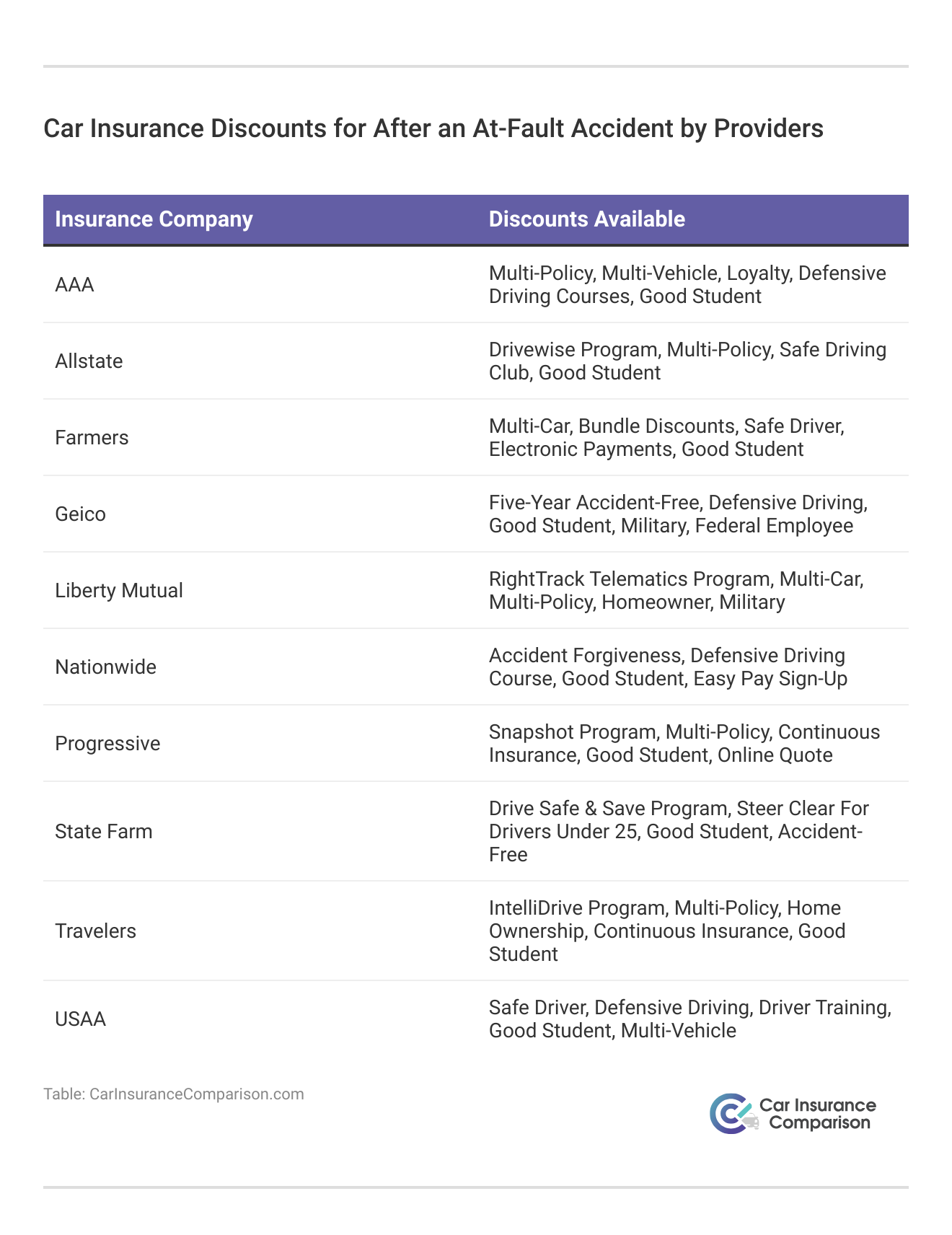
Many auto insurers offer loyalty rewards, good driver incentives, multi-policy discounts, and more that can help lower the cost of coverage after an at-fault accident. Check out some of the common discounts from our top companies below.
It’s also important to consider your coverage type. Reducing your coverage limits may lower your premiums but leave you with less protection.
Maintaining a clean driving record after the accident will help reduce future rate increases and potentially improve your credit score. These steps can help you get back on track financially after an at-fault accident and save money in the long run.
Car Insurance Rates in Fault vs. No-Fault States
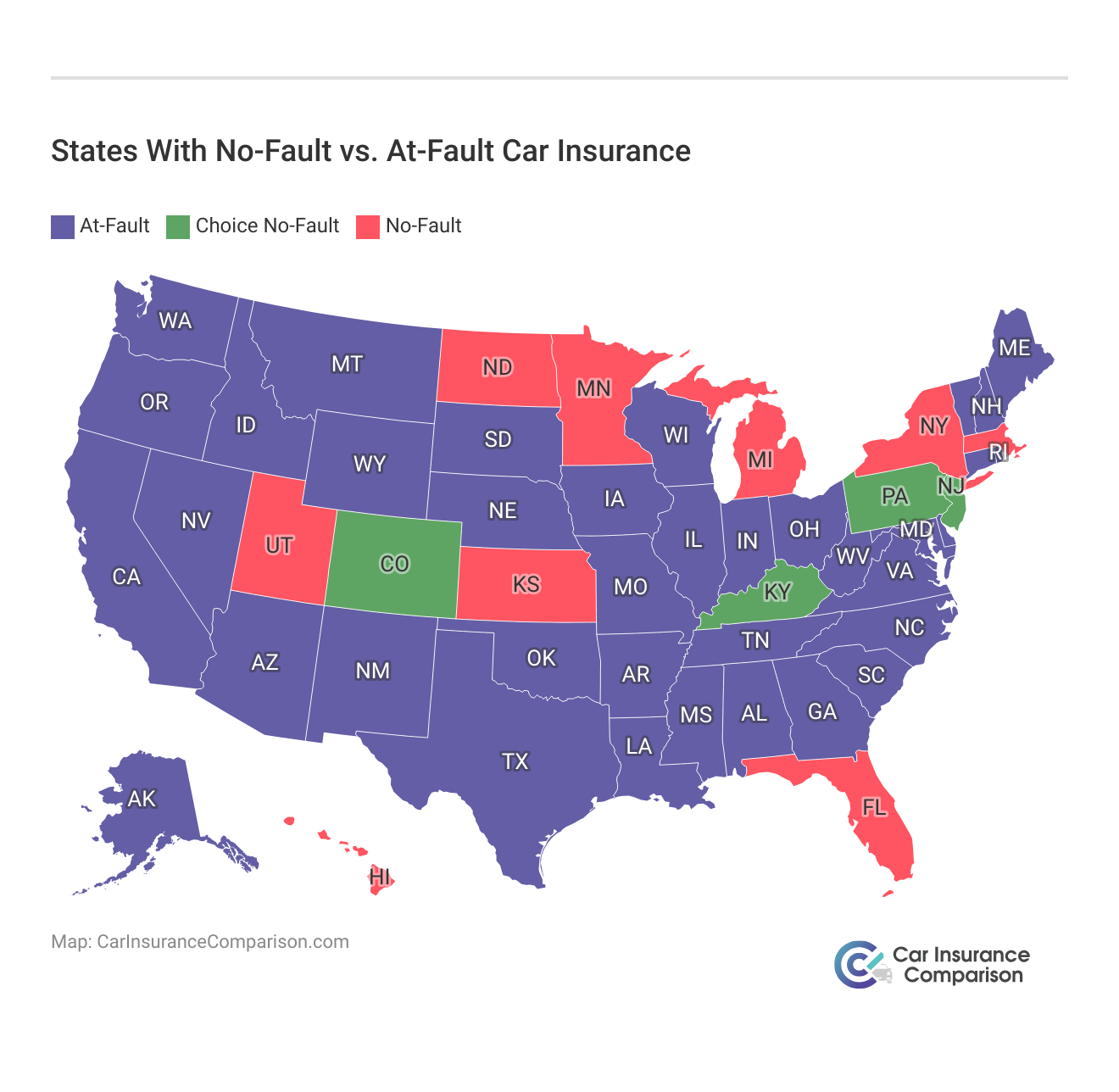
It is important to note that not all states use the same system for determining fault in an accident. Some states have what is known as a “no-fault” system, which means each driver’s insurance company pays for their respective damages regardless of who is at fault.
Read More: Compare No-Fault Car Insurance: Rates, Discounts, & Requirements
In other words, no effort is made to determine who was liable for the crash, and both parties file claims with their own insurer. This eliminates lengthy investigations into who was responsible and helps drivers get compensated faster.
Let’s break down both fault and no-fault states to give you a clearer picture of what this means for you.
Accidents in At-Fault States
In an at-fault state, the party responsible for causing a car accident is determined through investigations and court judgments. The insurance companies will likely look into all available evidence, such as witness statements, police reports, and photos of the scene and damage, to determine your level of responsibility (learn more: Can car insurance companies check police records?).
Insurance companies consider fault when deciding how much to pay for a claim and how much to raise or lower a driver’s premiums.
The process of determining fault can take some time and sometimes be challenging.
Depending on this investigation’s findings, you may be held fully liable or partially liable for the accident. Learn how to dispute a car insurance claim if you believe you are not at fault.
Accidents in No-Fault States
In a no-fault state, each driver’s insurance company pays for their respective damages regardless of who is at fault. In this system, neither driver’s insurer investigates or attempts to establish who was responsible for the crash — they pay out claims and move on.
This system may sound beneficial since it eliminates lengthy investigations. However, there are some downsides to the no-fault system.
For example, since each party’s insurer pays out regardless of fault, drivers can only recoup a certain amount from their own policy.
This means that if your damages exceed the coverage limit on your policy, you will have to cover all additional costs out of pocket.
Further, no-fault car insurance requires more coverage to pay for injuries, which raises your insurance rates. Here is a list of no-fault car insurance states:
How Fault Is Determined in Car Accidents
Who determines fault in a car accident? Well, determining fault in a car accident depends mainly on the rules and regulations of each individual state. In an at-fault state, fault is generally determined through investigations and court rulings.
The other driver’s insurance company will consider all available evidence to determine who was responsible for the crash, such as witness statements, police reports, photos of the scene, etc.
Depending on this investigation’s findings, one party may be held fully or partially liable for the accident.
In a no-fault state, determining fault is unnecessary since each driver’s insurance company pays out claims regardless of who caused the wreck. This helps drivers receive compensation quickly without lengthy investigations into liability issues. Read car insurance claim investigation guide for more information.
No matter where you live, it’s important to know your state insurance laws regarding fault determination and insurance claims. This knowledge can help you understand the steps that will be taken in the event of an accident and ensure that you get the coverage you deserve regardless of who is at fault.
Free Insurance Comparison
Compare Quotes From Top Companies and Save
Secured with SHA-256 Encryption
The Role of an Insurance Adjuster Explained
So what is an insurance adjuster and what do they do? An insurance adjuster’s job is to determine who was at fault in a car accident. They typically investigate the crash scene, speak with witnesses, and review photos, police reports, and other evidence to decide who was responsible for the incident.

Adjusters may also review medical records if any of the parties involved sought medical care following the accident.
Once all available information is collected and reviewed, they will assign a percentage of fault to each driver based on their findings. A single-vehicle car accident will affect your car insurance rates because the adjuster will likely determine that you were totally at fault if no other drivers were involved.
Consequences of Being At Fault in a Car Accident
What happens after a car accident that is your fault? There can be serious consequences if you are at fault in a car accident. First and foremost, you may be liable for any damages caused to the other party’s vehicle or property. This would include medical bills if any parties involved needed medical care following the incident.
You may also be held responsible for pain and suffering caused by an accident, which could include emotional trauma or physical injuries.
In an at-fault state, your insurance company will typically investigate to determine who is liable for the crash and how much each driver should pay out in claims.
Scott W. Johnson Licensed Insurance Agent
Depending on their findings, you may have to pay out more than just damage costs — you could also be required to pay fines or court fees. You may also face a rate increase or cancellation of your policy for being at fault.
On the other hand, if you are found to be not at fault for the accident, your insurance company will cover all damages, and you won’t have to worry about any of the potential consequences mentioned above.
What to Do After an At-Fault Accident
If you’re responsible for a car accident, you should take several steps:
- Make sure that everyone involved is safe and unharmed, and call 911 immediately if anyone needs medical attention.
- Exchange contact and insurance information with witnesses or drivers involved in the incident.
- Take photos of the crash scene to help document any damage caused by the accident.
- Write down details such as time of day, weather conditions, and road layout in case these factors play a role in later assigning fault.
Finally, contact your auto insurance provider as soon as possible to report the incident and begin the claims process.
Read More: If I am in a car accident, do I call their insurance or mine?
Your insurer will be able to help you navigate the complicated process of filing a car insurance claim and ensure that all parties involved receive fair compensation for their damages.
Car Insurance After an At-Fault Accident: The Bottom Line
There are many factors to consider when it comes to car insurance after an at-fault accident. Your premiums may increase significantly after the incident if your insurer finds you liable for damages or injury.
Read more: Best Accident Insurance Companies
You can take steps to mitigate any rate hikes and reduce the cost of coverage moving forward, including shopping around quotes and reducing your car insurance coverage limits.
Ultimately, the best way to protect yourself and save money is to practice safe driving habits, shop around for new policies, and look into available discounts. With the right plan, you can keep your car insured after an accident without breaking the bank. Ready to find cheaper car insurance coverage? Enter your ZIP code below to begin.
Frequently Asked Questions
What happens if I am found at fault in a car accident?
If you are found at fault in a car accident, you may be liable for damages and injury to the other driver or drivers involved. This could result in increased car insurance premiums or even legal action, depending on the severity of the incident. Read more about factors that affect car insurance rates.
Should I report a minor car accident that was my fault?
Yes, you should always report any car accidents to your insurance company, even if they are minor. This is necessary as the other driver might still submit a claim, and having all the details is crucial for your insurance company in the event of any legal challenges.
Will my insurance fix my car if I am at fault in an accident?
Yes, if you have collision coverage as part of your auto insurance policy, it will cover the repairs to your car even if the accident was your fault. This coverage is optional and comes with a deductible that you’ll need to pay out of pocket before your insurer pays for the damages.
Does my insurance cover accidents if I’m at fault?
If you’re at fault in an accident, your liability insurance will cover damages and injuries to the other party up to your coverage limits. However, for damages to your own vehicle, you’ll need collision coverage. Personal injury protection (PIP) or medical payments coverage can help with your medical expenses, regardless of who is at fault.
What should I do after causing a car accident?
Immediately after an accident for which you’re at fault, ensure everyone’s safety and call emergency services if needed. Then, exchange information with the other driver(s) and document the scene with photos. Notify your insurance company about the accident as soon as possible to start the claims process.
How can I lower my car insurance after an at-fault accident?
There are a number of ways t o lower the cost of your insurance after an at-fault accident. You can shop around for new policies, taking advantage of available discounts and benefits programs offered by your current provider, reducing your coverage limits when possible, and maintaining a clean driving record.
Does insurance cover car damage if I am at fault?
Yes, if you have collision coverage, your insurance will cover the damage to your car even if you’re at fault. Remember, collision coverage is not mandatory, so you need to have elected this coverage to benefit from it after an accident where you are at fault.
How is fault determined in a Nationwide car accident?
If you’re found at fault for causing a car accident, it will likely impact your insurance rates and potentially result in a surcharge. Fault can be determined through various factors such as police reports, witness statements, and physical evidence from the scene.
How is fault determined in a Nationwide car accident?
If you’re found at fault for causing a car accident, it will likely impact your insurance rates and potentially result in a surcharge. Fault can be determined through various factors such as police reports, witness statements, and physical evidence from the scene. In some cases, both parties may share fault and the claims process can become more complex.
Do I have to pay for damages if I am found at fault in a car accident?
If you are found to be at fault in an accident, you may be liable for any damage. Depending on the circumstances, your insurer may cover some or all of these costs. It’s essential to contact your auto insurance provider as soon as possible after an incident. They will be able to help you with the process of filing a car insurance claim.
Does your insurance go up after a claim that is not your fault?
Who has the cheapest car insurance after an at-fault accident?
Does it matter who is at fault?
How much does insurance increase after a claim?
Does fault matter in no-fault states?
Related Articles




Get a FREE Quote in Minutes
Insurance rates change constantly — we help you stay ahead by making it easy to compare top options and save.
Secured with SHA-256 Encryption