

Understanding Your Car Insurance Policy (Complete Guide)
When understanding your car insurance policy, make sure to review your coverage, rates, deductibles, and any terms or exclusions you must adhere to. The Declarations Page is the front page of your policy and will list all of your coverages, insured vehicles, named drivers, qualifying discounts, and more.
Read more Secured with SHA-256 Encryption





Table of Contents
Table of Contents

Insurance Operations Specialist
Michael earned a degree in Business Management degree with an insurance focus, which led to a successful 25-year career in insurance claims operations and support. He possesses a high-level of business acumen across multiple areas of the insurance industry. Over the course of his career, he served in multiple roles supporting claims operations including: Claims Specialist, Claims Trainer, Claim Au...
Michael Leotta

Licensed Insurance Agent
Daniel Walker graduated with a BS in Administrative Management in 2005 and has run his family’s insurance agency, FCI Agency, for over 15 years (BBB A+). He is licensed as an insurance agent to write property and casualty insurance, including home, life, auto, umbrella, and dwelling fire insurance. He’s also been featured on sites like Reviews.com and Safeco. To ensure our content is accura...
Daniel Walker
Updated February 2024
- Not all car insurance policies will look the same and vary highly based on the company
- If you don’t confirm and verify all information listed on your policy, you could be denied claims in the future.
- There are different requirements for each state in the United States, so your policy should be tailored to not only your personal information but your state’s requirements as well.
So you’ve finally chosen the right car insurance company that fits your needs, and you get your insurance policy. If you’re taking a look at that policy for the first time, it might seem a little confusing. That’s what we’re here for.
Understanding your car insurance policy is important, so we’ve put together this guide to help you navigate all of this information.
Understanding Car Insurance for Dummies
We’ll start off with some basic car insurance terms and information that you’ll want to know before getting into the details.Once we’ve covered the basics, you’ll find it a lot easier to understand your policy.
Car Insurance Terms You Need to Know
There are so many different car insurance terms floating around these days that it can be extremely confusing. We’ve gone through to break down some of the most commonly used terms for your convenience:
| Common Car Insurance Term | Definition |
|---|---|
| Liability Coverage | The catch-all coverage that pays for damages incurred by other drivers if you're in an accident. It breaks down into two categories: bodily injury liability and property damage liability. |
| Bodily Injury Liability | The type of liability coverage that pays for any bodily injuries to another party (or death(s)) that occur as a result of an accident. |
| Property Damage Liability | The type of liability coverage that pays for any property damage that occurs as a result of an accident. |
| Medical Payments | Also known as MedPay, this is a type of additional liability coverage that will pay for your own medical costs incurred as a result of an accident. |
| Personal Injury Protection | Also known as PIP, this is a type of additional liability coverage that pays for the costs of any medical bills/funeral expenses incurred as a result of an accident, regardless of who was at fault. Unlike MedPay coverage, however, this type of additional liability coverage is mandatory in some states. |
| Uninsured/Underinsured Motorist Coverage | This is a type of additional liability coverage that will pay for expenses incurred if you are involved in an accident caused by another driver who has either less than the minimum required liability coverage, or who has no coverage at all. |
| Collision Coverage | This is a type of car insurance that helps to pay for any repairs to your car if it is damaged in an accident. It's very useful coverage if you ever find yourself the victim of a hit-and-run accident. |
| Comprehensive Coverage | This type of coverage will pay for damage to your vehicle that is not caused by an accident, such as damage from a natural disaster or vandalism. |
| Roadside Assistance | This type of coverage ensures you'll get some assistance out on the road if you need it, like emergency towing, help with your battery, changing a flat tire, and lockout assistance. |
| Gap Insurance | This type of coverage is designed to help cover the difference between the actual value of your vehicle after an accident and the amount you owe on your vehicle. This is a valuable coverage type for new vehicles. |
| No-Fault Insurance | This type of coverage typically only applies to states that fall under the no-fault system. It's meant to help prevent any delays in medical payments for injuries you might get as a result of an accident. |
| Declarations Page | Essentially, this is the information page of your insurance policy. It should be the first page(s) that details information about your policy, such as the names of those insured under the policy, your address, how long the policy period is for, your policy limits, and other key information. |
| Insuring Agreement | This is the portion of your insurance policy in which your insurance provider promises to make any payment to (or for) you should you need coverage. It's the legally binding part of the policy on your insurer's part. |
| Exclusions | This is a provision (or addendum) on your insurance policy that basically states which things are not covered by your policy (such as hazards, perils, circumstances, or property). Think of this part as the fine print for your agreement with your insurance provider. |
| Conditions | This is the section of your insurance policy that states any requirements or rules (for both you and your provider) that must be followed for matters such as loss reporting and settlement, property valuation, other insurance, and cancellation and non-renewal. |
| Insurance Premium | This is the amount of money an insurer charges you in order to provide the coverage described in the policy. |
| Insurance Deductible | This is an amount your insurance provider will deduct from the loss before paying up to its policy limits. Basically, it's the amount you need to pay for any costs from an accident before your provider will pay for their part. |
If you want further information and explanation on some of these terms, make sure to check out some of our other helpful guides.
Mandatory Car Insurance Coverage
Most states across the nation require something known as minimum liability coverage. This is a minimum amount of liability coverage that you must have in order to legally drive in that state.Not all states in the nation require drivers to have car insurance, but a large majority do, so make sure you know about the insurance laws where you live.
- Car Insurance Basics
- What Is a Car Insurance Premium?
- How to Get Car Insurance
- How long after buying a car do you need to get insurance coverage?
- Car Insurance Guide
- How do you find your car insurance deductible?
- How long does it take to get car insurance?
- Is Esurance owned by Allstate?
- Does having a garage lower the cost of car insurance?
- Car Insurance Market Value: Explained Simply
- Learning About High-Risk Car Insurance
- How do you lower your car insurance deductible?
- Who is Flo from the progressive commercials?
- Car Insurance FAQ
- Understanding Your Car Insurance Policy
- I can’t remember my car insurance company, how do I find it?
- What to Do if You Can’t Find Your Car Registration
- How to Get Help Paying for Car Insurance [2026]
- What happens if I can’t afford my car insurance?
- Can I get car insurance on the weekend?
- Can you pay your car insurance yearly?
- Can you renew your car insurance early?
- Can I change the date my car insurance is due?
- Can I pay car insurance quarterly?
- Are car insurance companies open on bank holidays?
- Are car insurance companies open on weekends? [2026]
- Can I add my girlfriend to my car insurance policy?
- Car Insurance Payment Methods
- How do you use a policy number to identify a car insurance company?
Free Insurance Comparison
Compare Quotes From Top Companies and Save
Secured with SHA-256 Encryption
Understanding Your Car Insurance Policy
Now that we’ve covered some of the basics that you need to know, we’ll move on to learning more about your car insurance policy.In this section, we’ll discuss the key pieces of information you will need to pay the most attention to while reviewing your insurance documents.
Sample Car Insurance Policy
Take a look at our sample car insurance policy to see what kind of information you’ll likely find, which we’ll explain in the sections below.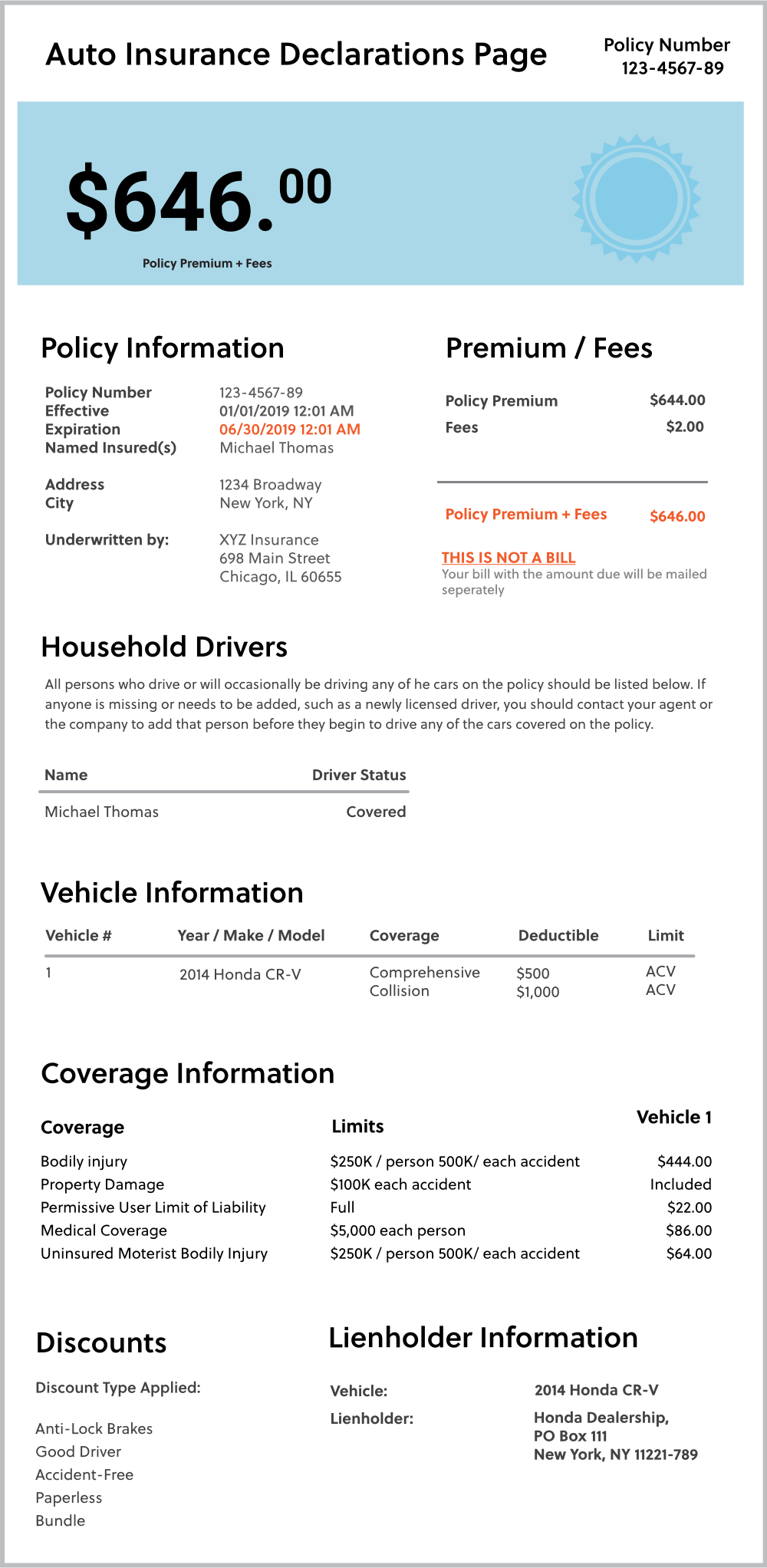
Declaration Page
A Declaration page is typically the front page of your insurance policy that contains all of the important information about your policy.What kind of information does it contain?The declaration page of your policy typically contains some (if not all) of the following:
- The name of the person(s) being insured (this information may also appear in a separate section, like in our sample policy above, under Household Drivers)
- Mailing address
- Physical address
- The policy period
- The policy number
- Covered vehicle make, model, and VIN
- Coverage for each listed vehicle
- Lender names and addresses
- Listed driver(s) and date(s) of birth
- Driver assignments
- Violation types
- Chargeable accidents
- Applicable discounts
So you can see why this page is so important, right? It’s essentially a general summary of all of the pertinent facts about your insurance policy.While it may seem tempting to just glance over this and sign on the dotted line, it is essential that you read over all of the details on this page.Why?Let’s say you accept your insurance policy without looking carefully at it, and fast forward a few months later and you’re in an accident.You go to file a claim with your insurance provider, but you failed to make sure that your name and address were correct. They would then likely deny it because the information you file your claim with doesn’t match what they have on your policy.So if you take anything away from this section, it is to make sure that you read every detail on your Declaration page. It could save you from a major headache in the future.
Policy Number
Your auto insurance policy number is how the car insurance provider identifies individual policyholders and keeps track of all of the information related to their policies.It is chosen by the company itself, so there is no way to know how many digits will be in your specific policy number without seeing your actual policy documents. Every auto insurance company is responsible for issuing its own set of policy numbers according to its own policies and records. There is no universal system for determining the digits and what they mean in an auto insurance policy number.So if you need to find out what your specific car insurance policy number is, you should check on your proof of insurance card or pull out your auto insurance policy. It will always be listed on the declarations page of your car insurance policy.
Read more:
- Car Insurance Policyholder: Explained Simply
- Car Insurance Tier System: Explained Simply
- How do you use a policy number to identify a car insurance company?
- How do I find my car insurance policy number?
- What is the difference between car make vs. model?
Vehicles Covered
This section outlines what vehicles will be covered under your insurance policy.If you’re insuring just one vehicle, all of that vehicle’s identifying details will be listed. If you’re insuring multiple vehicles, the policy will list all of the details for each individual vehicle.What kind of details are shown?Well, typically, the following vehicle information might show up in this section:
- Make/Model of the vehicle(s)
- Vehicle(s) Identification Number (VIN)
- Overview of the specific coverage for each vehicle
- Premium or deductible for each vehicle
- Policy limit for each vehicle
These items may vary depending on what insurer you’re doing business with, but these are some of the typical items you’ll find in this section.
Total Rates
This section is very important. Why?The total premium tells you exactly what you’re agreeing to pay for your insurance coverage.It will either be the total you have to pay for just your one vehicle or if you’re insuring multiple vehicles, it will be the total amount you’ll pay for your premium for all vehicles listed.For example, let’s say you’re buying insurance for just one vehicle for $500. Your total premium will be shown as $500.Now let’s say you decide to insure three vehicles for your family. The premium for the first car is $300, the premium for the second car is $200, and the premium for the third car is $400.Your total premium in this situation would be $900.
Car Insurance Discounts
If you qualify for any discounts with your insurance provider, you’ll find those listed as well. You can see some of the most common car insurance discounts, as well as how much you can save, in the table below:
| Discount | Average Savings | Category |
|---|---|---|
| Affiliation or "affinity" | 25% | Affiliations |
| Good or safe driver | 20% | Driving history |
| Senior | 15 - 35% | Demographic |
| Good student | 15 - 25% | Demographic |
| Customer loyalty | 15 - 25% | Customer loyalty |
| Military | 15% on base, 90% for deployed | Affiliations |
| Multi-car | 10 - 25% | Customer loyalty |
| Anti-lock brakes | 10% | Equipment-related |
| Defensive driving course | 10% | Driver training |
| Early signing/renewal | 10% | Customer loyalty |
| Green/hybrid car | 10% | Equipment-related |
| New car | 10% | Equipment-related |
| Driver training | 8 - 10% | Driver training |
| Anti-theft | 5 - 20% | Equipment-related |
| Bundled | 5 - 10% | Customer loyalty |
| Paid-in-full | 5 - 10% | Payment |
| Homeowner | 5 - 15% | Demographic |
| Accident-free | 5% | Driving History |
| Emergency road assistance | 5% | Affiliations |
| Safety; passive restraint and air bag | 5% | Equipment-related |
| Paperless | 3% | Payment |
| Usage or low-mileage | 2% | Driving history |
| Auto-pay | $45 - $50 / year | Payment |
| Low income or occupation | Varies | Demographic |
There also may be certain times when insurance companies will issue refunds. This can occur when an event significantly reduces the amount of traffic on the road, such as when the coronavirus pandemic reduced the overall traffic and therefore accidents on the road.
Coverage
You’ll also find all of the coverage options you have selected for your insurance policy, as well as the limits for these coverage types.Here’s a basic rundown of what kind of coverage you will find, according to the National Association of Insurance Commissioners (NAIC):
- Liability Coverage:
- Bodily Injury Coverage
- Property Damage Coverage
- Additional Liability Coverage:
- Medical Payments (MedPay)
- Personal Injury Protection (PIP)
- Uninsured/Underinsured Motorist Coverage
- Vehicle Coverage:
Keep in mind that if you’re insuring more than one vehicle, the coverage types will be listed by vehicle.If you’d like to see a more in-depth description of each coverage type, take a look at our earlier section on basic car insurance terms.
Deductibles and Premiums
Depending on your specific provider’s documentation, the deducible and premium you’ll be paying for your vehicle may be found within another section, or it could be in a section all its own. There’s a big big difference between your deductible and your premium.We won’t go too far in-depth, as we have already previously defined each in the section on basic car insurance terms, so just to refresh your memory:Your premium is the amount you pay to insure your vehicle.Your deductible is the amount you will pay out of pocket for any damage to your vehicle after an accident.
The important thing to note about these two is that, depending on what kind of insurance coverage you have chosen, you may not have a deductible. But you will always have a premium to pay.
Policy Terms
The policy terms section is the catch-all repository for all the important specifics about your policy. All of the items up until this point have been about your coverage, your premiums/deductibles, etc. This part of the document is solely about your agreement with your insurance provider.
In this section, you will see some of the following items:
- Policy Period – How long your policy will cover you for
- Expiration Date – When your policy will expire
- Effective Date – When your policy will begin covering you
- Lienholder Information – If you do not fully own your vehicle (i.e., you’re still paying for your vehicle or you’re leasing), this will be the information for your lienholder.
- Example: Let’s say you bought a new Porsche recently, but you’re making payments on it to the Porsche dealership. Information about that Porsche dealership would be listed here.
Keep in mind that all of this information may not be in the same place. It depends on how your insurer sets up their Declaration page.
What isn’t covered under my car insurance policy?
Knowing what is and what is not covered under a car insurance policy can save you time, money, and frustration down the road. A car insurance policy covers a variety of different eventualities that may occur in the operation of your vehicle. However, it does not cover everything. There are exceptions to all types of insurance protection.
Car Insurance Policies will Not Cover Deliberate Acts and Fraud
One thing that is never covered by car insurance is a deliberate act. If you intend to damage your vehicle for any reason, your car insurance provider should and will reject any claims that arise from it.Car insurance is not a way to afford another vehicle if you discover that you no longer want the one you have. It is simply a form of security to protect you in the case of an accident.Fraud is a huge problem in the car insurance industry. Many people attempt to “pull one over” on their insurer and often justify it as a David and Goliath situation.
They believe that such actions are victim-less crimes and insurers can easily afford it.
However, insurance rates are constantly rising because of such incidents. Insurers also take more time to pay claims in many situations because they need to investigate each one to ensure that no fraud is involved. Fraud can involve a variety of different things. Some of the more serious cases involve crime rings that stage accidents and even have doctors and other professionals involved.However, fraud can also be a single client lying or omitting information that could impact his premiums. If your insurer finds out that you have not been completely honest with him, you can expect to have claims not paid or your policy may even be canceled.
Car Insurance Policies will Not Cover Normal Repairs or Personal Property
Car insurance does not cover mechanical repairs that are caused by regular wear and tear. If your vehicle needs to be repaired but the problem resulted from regular use, your visit to the mechanic will not be covered.Even if you have comprehensive insurance coverage, personal property that is stolen from your vehicle will not be covered. Even though comprehensive coverage provides for theft, it is only for theft of the vehicle itself or for things attached to the vehicle, such as stereos.If you have left a collection of CDs or other items in the car and they are stolen, you will need to make a claim under your home insurance.Another consideration with car insurance policies is the limit of coverage. This means that even if your policy pays a claim for loss, it will not pay more than the policy limit. Therefore in serious accidents, you may come up short on coverage with your car insurance policy.If your vehicle is financed, you will need to carry collision and comprehensive coverage to protect it. However, if the vehicle is a total loss, the insurer will payout based on the blue book value of it, not the amount you have outstanding on the note. Therefore, it is important to invest in gap insurance to make sure that your insurer will cover your total loss and you will not be stuck paying off a car you no longer have.
Apart from these general guidelines, there may be some individual differences in what a car insurance policy from one insurer to another covers.
This is because the definition of full coverage varies slightly between companies, with some companies giving more extensive coverage than others. In order to make sure you know what is and what is not covered under your car insurance policy, you should talk with your insurance agent.
Renewing your Car Insurance Policy
If you decide that you like your existing car insurance policy, you will need to renew it.Why not check out our guide covering exactly how to do that?
Case Studies: Understanding Your Car Insurance Policy
Case Study 1: Coverage Types and Levels
Sarah recently purchased a new car and wanted to ensure she had adequate insurance coverage. She reviewed her car insurance policy and discovered that she had chosen the minimum liability coverage required by her state.
After doing some research and considering her financial situation, Sarah decided to increase her coverage levels to protect her assets in the event of a major accident. This highlights the importance of understanding coverage types and choosing appropriate levels based on individual needs.
Case Study 2: Rates and Deductible
John received his car insurance renewal notice and noticed that his premium had increased significantly. He decided to compare quotes from other insurance companies and found a policy with the same coverage at a lower rate.
However, the new policy had a higher deductible. After carefully considering his budget and the potential out-of-pocket costs in case of an accident, John decided to switch to the new policy. This emphasizes the significance of comparing rates and understanding the trade-offs between premiums and deductibles.
Case Study 3: Policy Terms
Emily was involved in a minor accident and needed to file a claim with her insurance company. However, when she reviewed her policy terms, she realized that she had missed the deadline for reporting accidents.
As a result, her claim was denied. This underscores the importance of familiarizing oneself with the terms and conditions of a car insurance policy to ensure compliance with the requirements.
Case Study 4: Understanding the Declaration Page
Michael was in the process of purchasing a new car and needed to add it to his existing insurance policy. He reviewed the declaration page of his policy and found that his new vehicle wasn’t listed.
Michael promptly contacted his insurance provider to update his policy and ensure that his new car was properly covered. This highlights the significance of carefully reviewing the declaration page and verifying the accuracy of the listed information.
Frequently Asked Questions
How do you read and interpret an insurance policy?
When reviewing your car insurance policy, make sure to review your coverage types and levels, rates and deductibles, and the terms you must adhere to.
Are drivers in all states in the U.S. required to have car insurance?
All states require drivers to have car insurance except New Hampshire and Virginia.
What is a car insurance policy number, and where can I find it?
A car insurance policy number is how the insurance provider identifies individual policyholders. It can be found on your proof of insurance card or the declarations page of your policy.
What do the coverages mean on car insurance?
The numbers listed as “25/50/25” on your insurance card, for example, stand for the liability limits on your policy. This coverage means you have $25,000 in coverage per person and $50,000 per accident for personal injuries, and $25,000 for property damage you cause.
What is recommended for car insurance coverage?
Common coverage types include liability coverage, collision coverage, comprehensive coverage, personal injury protection, and uninsured/underinsured motorist coverage.
What discounts can I get on my car insurance policy?
Car insurance companies offer various discounts, such as safe driver discounts, multi-policy discounts, and good student discounts, which can help you save money on your premiums.
What are the most important things to look for in car insurance?
The most important thing to look for in car insurance is meeting your legal liability requirements. You may also need to carry additional coverage to meet the terms of your auto loan or lease.
What is the difference between a deductible and a premium in car insurance?
A premium is the amount you pay to insure your vehicle, while a deductible is the amount you will pay out of pocket for any damage to your vehicle after an accident.
Does my car insurance declaration page count as proof of insurance?
Your page doesn’t count as official proof of insurance. Instead, you will need an insurance card. An insurance card is issued to the driver instantly on a mobile app and usually within two weeks of purchase by mail. The company usually sends two cards to the driver for convenience and will also send proof of car insurance to local the Department of Motor Vehicles.
Do I have to pay my car insurance in full or monthly?
Most car insurance companies allow policyholders to pay car insurance monthly, annually, or every six months. Some high-risk drivers may have to pay car insurance upfront with some companies, depending on their records.
How long do I need to keep my car insurance policy?
Can I change car insurance in the middle of my policy?
Related Articles
-
Dec 2023

What vehicles are exempt from car insurance requirements?
-
Apr 2024

Best Senior Citizen Car Insurance Discounts in 2026 (Top 10 Companies Ranked)
-
Jan 2024

What questions do car insurers ask?
-
Feb 2024

What insurance coverage is required for a food truck in Connecticut?
-
Jan 2024

Where can I find the lowest car insurance quotes?





Get a FREE Quote in Minutes
Insurance rates change constantly — we help you stay ahead by making it easy to compare top options and save.
Secured with SHA-256 Encryption